
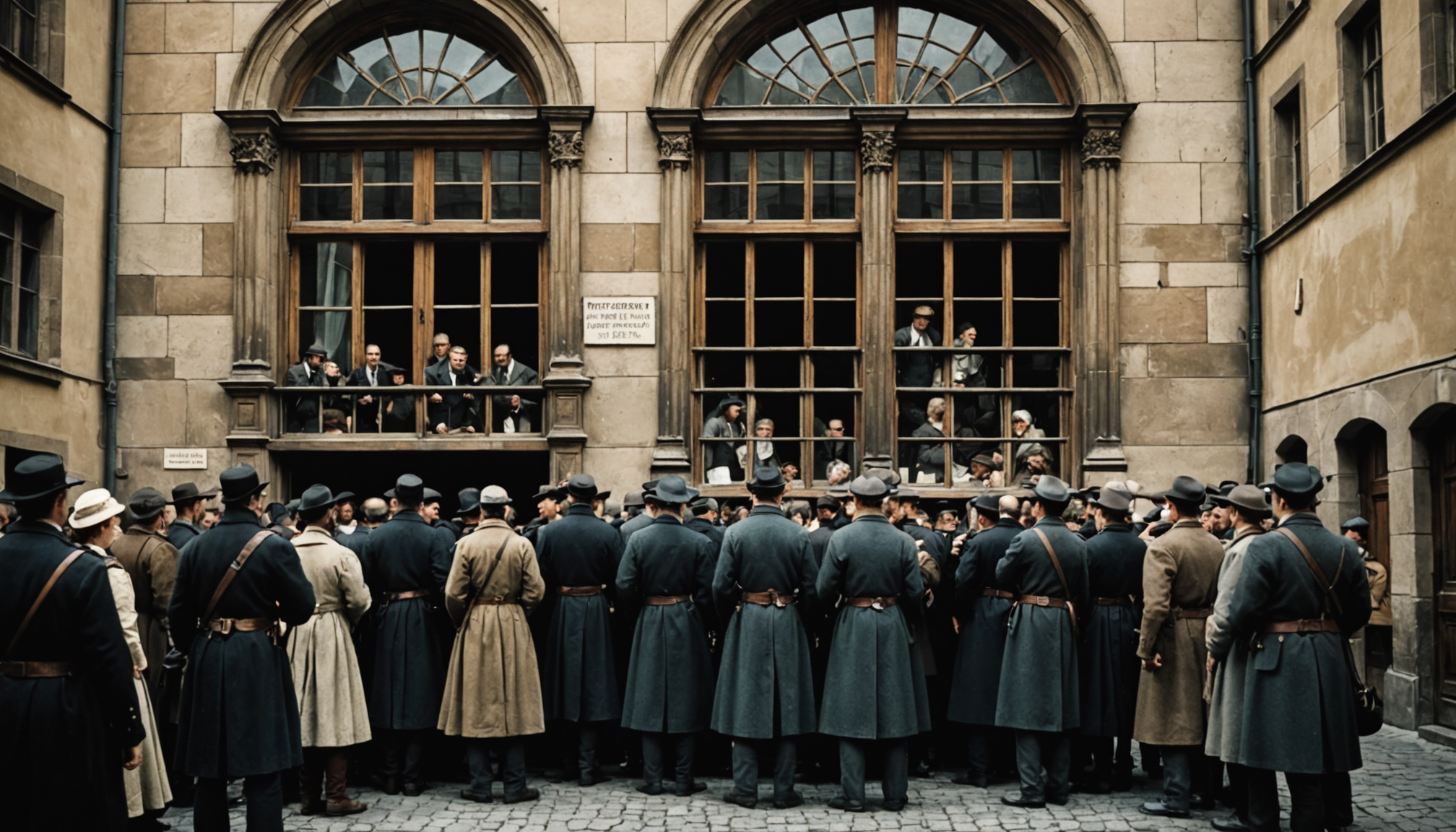
On a chilly day in May 1618, the air in Prague was thick with tension, a palpable unease that seemed to cling to the cobblestones and swirl around the spires of St. Vitus Cathedral. It was here, in the heart of Bohemia, that a group of Protestant nobles made a fateful decision that would echo through the annals of history. They hurled two Catholic officials out of a window of Prague Castle, an act that would not only mark the beginning of a violent conflict but also become a symbol of resistance against oppression. The Defenestration of Prague, as it would come to be known, was not merely an act of rebellion; it was a moment steeped in the complexities of faith, power, and identity, a flashpoint that ignited the flames of the Thirty Years War.
The event itself was both dramatic and absurd, a collision of political machinations and personal grievances that played out against the backdrop of a divided Europe. The two officials, Jaroslav Bořita of Martinice and Vilem Slavata of Chlum, were thrown from the window by their Protestant adversaries, landing in a pile of manure that cushioned their fall. This bizarre twist of fate did little to diminish the significance of the act; rather, it underscored the absurdity of the times. The Defenestration was not just an isolated incident but a culmination of decades of religious strife and political maneuvering that had left Bohemia teetering on the brink of chaos.
The Events Leading Up to the Defenestration
To understand the Defenestration of Prague, one must first delve into the turbulent landscape of early 17th-century Europe. The Protestant Reformation had fractured Christendom, creating deep rifts between Catholics and Protestants. In Bohemia, where religious tensions simmered beneath the surface, the Habsburgs sought to consolidate their power and enforce Catholic orthodoxy. This imposition was met with fierce resistance from the predominantly Protestant nobility, who felt their rights and freedoms were being systematically eroded.
The situation escalated in 1609 when Emperor Rudolf II issued the Letter of Majesty, granting religious freedoms to Protestants in Bohemia. However, this fragile peace was short-lived. Rudolf’s successor, Matthias, was less tolerant and sought to reassert Catholic dominance. The nobles grew increasingly frustrated as their grievances went unaddressed. They felt cornered, their voices drowned out by the imperial decree that favored Catholicism. The air crackled with resentment as they gathered in secret meetings, plotting their next move while the scent of burning candles mingled with the musty odor of old parchment.
As tensions mounted, a series of provocations further inflamed the situation. In 1617, Catholic officials began to dismantle Protestant churches and restrict their practices, igniting outrage among the nobility. The Protestant leaders felt betrayed by their own emperor, who had once promised them protection. It was against this backdrop of betrayal and desperation that the stage was set for an act that would change the course of history.
The Defenestration of Prague: The Incident

On that fateful day in May 1618, the sun hung low in the sky, casting long shadows across the cobblestone streets as a group of Protestant nobles made their way to Prague Castle. Their hearts raced with a mix of fear and determination; they knew they were about to cross a line that could not be uncrossed. As they entered the castle, they were met with an air of defiance and hostility from their Catholic counterparts. The tension was palpable, thick enough to cut with a knife.
Inside the castle’s grand hall, Jaroslav Bořita and Vilem Slavata stood before their accusers, unaware that they were about to become pawns in a larger game. The nobles confronted them with accusations of tyranny and betrayal, their voices rising in fervor as they demanded accountability for the injustices inflicted upon their people. In that moment, reason gave way to passion; words turned into actions as they seized their adversaries and hurled them from the window.
The sight was surreal—a moment suspended in time as Bořita and Slavata plummeted toward the ground below. Yet fate intervened; they landed not on solid earth but rather on a pile of manure that softened their fall. As they scrambled to their feet, dazed but alive, they could hardly comprehend what had just transpired. The act was both a declaration of war and an assertion of agency; it was a moment that would reverberate through history.
The Aftermath of the Defenestration

In the immediate aftermath of the Defenestration, chaos erupted throughout Prague. News spread like wildfire, igniting passions on both sides of the religious divide. The Protestant nobles had crossed a threshold; they had declared their defiance against imperial authority in a manner that could not be ignored. The air was thick with uncertainty as both sides braced for retaliation.
The Habsburgs responded swiftly and decisively. They viewed this act not merely as an affront but as a direct challenge to their rule. Troops were mobilized, and tensions escalated into open conflict. The streets of Prague became battlegrounds as loyalists clashed with rebels, each side fueled by fervent beliefs and deep-seated grievances. The city itself transformed into a crucible of violence and fear, where neighbors turned against one another and friendships were shattered by ideology.
As months turned into years, what began as a localized conflict spiraled into something far more significant—the Thirty Years War. This brutal conflict would engulf much of Europe, leaving devastation in its wake. The Defenestration had set off a chain reaction that would alter the course of history for generations to come.
The Defenestration of Prague and the Outbreak of the Thirty Years War
The Defenestration served as both catalyst and symbol for the Thirty Years War—a conflict that would ravage Europe from 1618 to 1648. What began as a struggle for religious freedom morphed into a complex web of political alliances and territorial ambitions. The war drew in major powers like Sweden, France, and Spain, each seeking to exploit the chaos for their own gain.
As battles raged across the continent, the initial grievances that had sparked the conflict became obscured by layers of ambition and revenge. Cities were besieged; entire populations were displaced or decimated by famine and disease. The war’s brutality left scars on the land and its people—scars that would take generations to heal.
In this maelstrom of violence, the Defenestration remained a potent symbol for those who resisted oppression. It became an emblematic act for Protestants across Europe who saw it as a rallying cry against tyranny. Yet for others, particularly Catholics loyal to the Habsburgs, it represented treachery and rebellion—a reminder that faith could fracture communities and lead to unimaginable suffering.
The Defenestration of Prague: A Symbol of Resistance
Sure, here is the sentence with the clickable link:
Listen to the Strange Epochs podcast for fascinating stories and discussions about history and the unexplained.
The act of defenestration transcended its immediate context; it became woven into the fabric of European identity during an era marked by religious conflict and political upheaval. For many Protestants, it symbolized courage in the face of oppression—a bold stand against an imperial power that sought to impose its will upon them. It resonated deeply with those who felt marginalized or silenced by authority.
In literature and art, the Defenestration found its place as a powerful motif representing resistance against tyranny. Artists captured its drama on canvas; poets immortalized its significance in verse. It became more than just an event; it morphed into an idea—a rallying point for those who sought to challenge injustice in all its forms.
Yet this symbolism was not without its complexities. While it inspired many to rise against oppression, it also served as a reminder of how quickly ideals could devolve into violence. The very act that represented resistance also unleashed chaos upon Europe—a duality that continues to resonate in discussions about power dynamics and civil disobedience today.
The Impact of the Defenestration on European Politics
The ripples created by the Defenestration extended far beyond Bohemia’s borders; they reverberated through European politics for decades to come. As nations grappled with questions of sovereignty and religious identity, alliances shifted like sand beneath their feet. The Habsburgs found themselves embroiled in conflicts on multiple fronts as they sought to maintain control over their vast empire.
The war’s aftermath saw significant changes in political landscapes across Europe. The Peace of Westphalia in 1648 marked a turning point; it established principles that would shape international relations for centuries—principles such as state sovereignty and non-interference in domestic affairs. These ideas emerged partly from lessons learned during conflicts like those ignited by the Defenestration.
In this way, what began as an act rooted in local grievances evolved into a broader discourse about governance and authority—one that questioned how power should be wielded and who should wield it. The Defenestration became emblematic not only of resistance but also of the complexities inherent in navigating power dynamics within diverse societies.
The Defenestration of Prague in Art and Literature
Throughout history, artists and writers have drawn inspiration from pivotal events like the Defenestration of Prague—transforming them into narratives that resonate across time and space. In paintings capturing its dramatic essence, one can almost hear the gasps from onlookers as officials tumble from windows amidst swirling clouds of dust and debris.
Literature too has embraced this momentous act; poets have penned verses reflecting on its significance while playwrights have dramatized its implications on stage. These artistic interpretations serve not only as historical accounts but also as explorations into human nature—the motivations behind rebellion, fear, courage, and ultimately sacrifice.
Yet these representations are often layered with interpretation—each artist or writer infusing their work with contemporary concerns or personal beliefs about authority and resistance. As such, while they capture an event rooted in history, they also reflect ongoing struggles within society—struggles that continue to resonate today.
The Defenestration of Prague: Legacy and Historical Significance
The legacy left by the Defenestration is multifaceted; it serves as both a cautionary tale about unchecked power and an enduring symbol for those who resist oppression. Its historical significance lies not only in its immediate consequences but also in how it shaped subsequent generations’ understanding of authority—how individuals can challenge systems perceived as unjust.
In examining this legacy through various lenses—political theory, social movements, or cultural expressions—one finds threads connecting past struggles with contemporary issues surrounding governance and civil rights. The act itself may have been singularly dramatic but its implications reverberate through time—reminding us that moments like these can alter trajectories far beyond their initial context.
As societies grapple with questions about justice today—whether through protests against systemic inequality or calls for accountability from leaders—the lessons learned from events like the Defenestration remain relevant reminders about courage amidst adversity.
The Defenestration of Prague: Commemorations and Remembrance
In modern-day Prague, echoes of this historical event linger in public consciousness—a reminder etched into both memory and landscape alike. Commemorative plaques adorn buildings where significant moments unfolded while annual events draw locals together to reflect on their shared history.
These commemorations serve not only as tributes to those who fought for freedom but also as opportunities for dialogue about ongoing struggles against oppression—inviting reflection on how far society has come since those tumultuous days while acknowledging challenges still faced today.
Through these acts of remembrance—whether through ceremonies or artistic expressions—communities reaffirm their commitment to preserving history while fostering conversations about justice and equity moving forward.
The Defenestration of Prague: Lessons for Modern Diplomacy
As diplomats navigate complex international relations today—often fraught with tensions reminiscent of those seen during early modern Europe—the lessons gleaned from events like the Defenestration remain pertinent reminders about communication strategies amidst conflict resolution efforts.
The importance placed upon dialogue over violence cannot be overstated; understanding grievances before resorting to drastic measures is crucial if societies hope to avoid repeating past mistakes marked by bloodshed or division.
Ultimately, while history may offer insights into human behavior during times fraught with tension—it is up to contemporary leaders to apply these lessons thoughtfully within their own contexts—ensuring that acts born out desperation do not overshadow opportunities for peaceful resolution amidst discordant voices clamoring for change.