
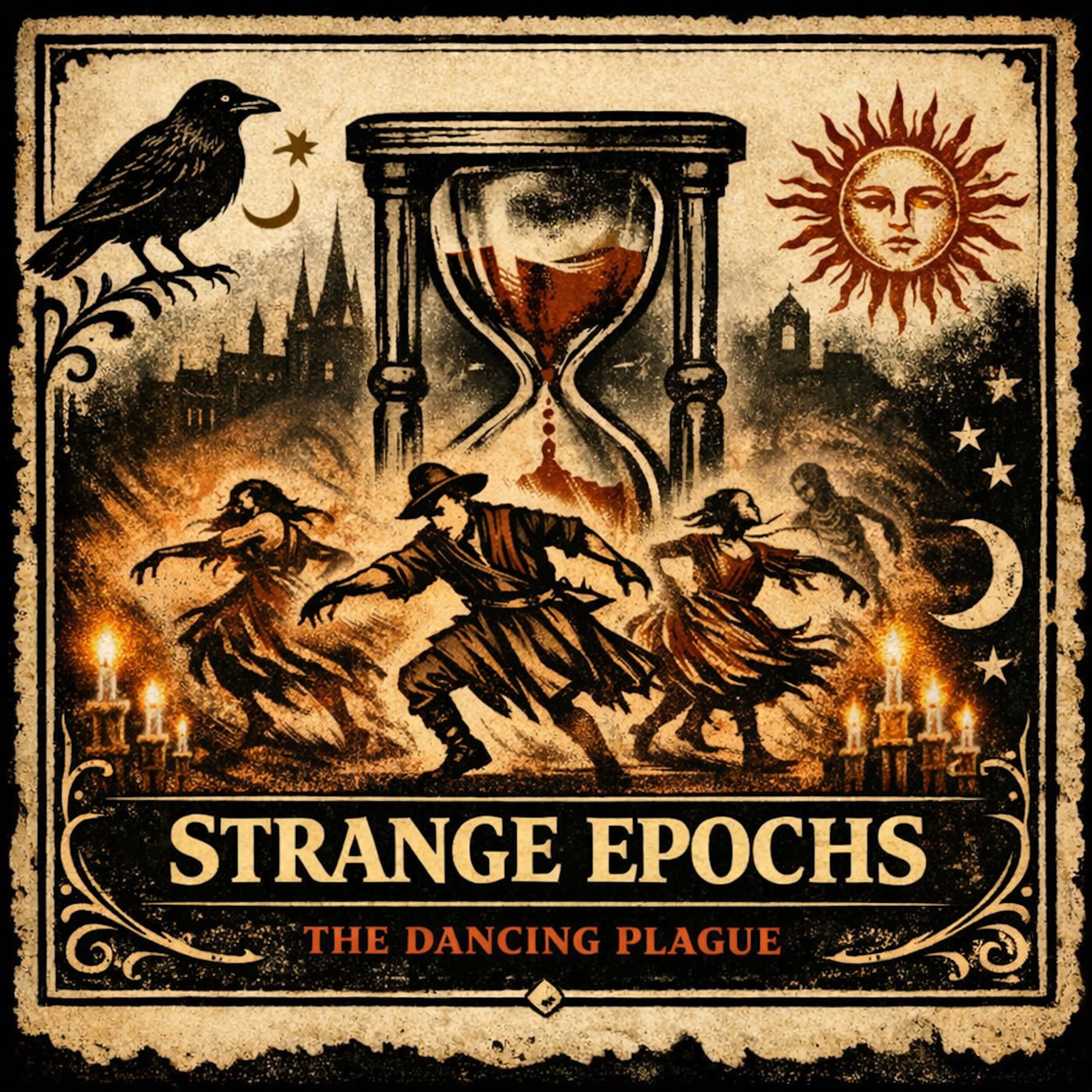
Episode Notes:
If you love history, true crime, or storytelling — or if you’re just looking for something to listen to on a long drive or drift off to sleep — this one is for you.
In the summer of 1518, a woman named Frau Troffea stepped into the streets of Strasbourg and began to dance. She didn’t stop for days. Within weeks, dozens of others had joined her, and the city of Strasbourg found itself in the grip of one of the strangest, most inexplicable events in recorded history.
Host Shawn Spainhour guides you through the full story: the medieval world of famine, plague, and religious terror that made this outbreak possible; how city officials and physicians tried — and failed — to stop it; and the leading theories historians still debate today, from ergotism to mass psychogenic illness.
Strange Epochs tells true stories from history’s stranger corners. Each episode is written for deep listening — slow, atmospheric, and immersive. Whether you’re behind the wheel, unwinding after a long day, or settling in for sleep, this show is built to pull you in and carry you somewhere else.
Sources are listed below and in the show notes:
• Waller, John. A Time to Dance, A Time to Die: The Extraordinary Story of the Dancing Plague of 1518. Icon Books, 2008.
• Bartholomew, Robert E. Little Green Men, Meowing Nuns and Head-Hunting Panics: A Study of Mass Psychogenic Illness and Social Delusion. McFarland, 2001.
• Strasbourg City Council Records, July through September 1518. Archives de la Ville et de la Communauté Urbaine de Strasbourg.
• Bock, Hieronymus. Contemporary chronicle account of the dancing plague, circa 1518.
• Agrippa, Heinrich Cornelius. Contemporary account of the Strasbourg outbreak, circa 1518.
• Waller, John. “A Forgotten Plague: Making Sense of Dancing Mania.” The Lancet, Vol. 373, 2009.
• Bartholomew, Robert E., and Wessely, Simon. “Protean Nature of Mass Sociogenic Illness.” The British Journal of Psychiatry, Vol. 180, 2002.