
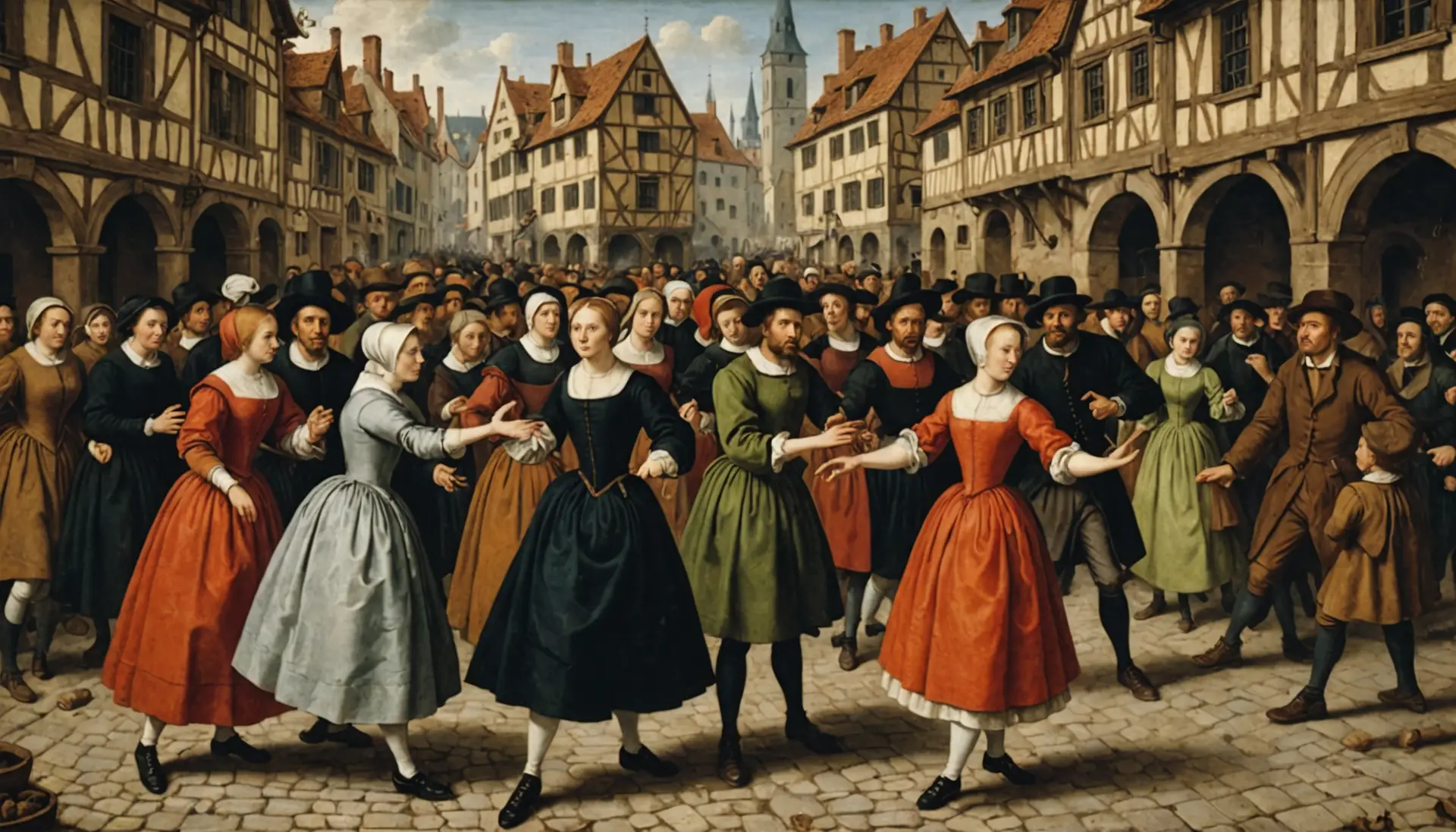
In the summer of 1518, the streets of Strasbourg, then part of the Holy Roman Empire, became a stage for an inexplicable phenomenon that would haunt the annals of history. It began with a woman named Frau Troffea, who stepped into the cobblestone square and began to dance. At first, it seemed like a curious spectacle, a moment of joy in a world often burdened by hardship. But as the days turned into weeks, her solitary jig transformed into a collective frenzy that would grip the town. The air was thick with the scent of sweat and desperation, as more and more townsfolk joined her in an uncontrollable rhythm, their bodies moving to a tune only they could hear. What started as a peculiar episode soon spiraled into chaos, leaving behind a legacy that would baffle historians and psychologists alike.
The outbreak in Strasbourg unfolded in July 1518, when the summer sun cast long shadows over the bustling marketplace. Frau Troffea’s initial dance was met with laughter and curiosity, but as her movements became frantic and relentless, the laughter turned to concern. Within days, others were drawn to her, compelled to join in this strange ritual. The town’s residents watched in disbelief as men and women, young and old, succumbed to an inexplicable urge to dance. The square became a cacophony of shuffling feet and gasps for breath, as if some unseen force had taken hold of their very souls. The townspeople were not merely spectators; they were witnesses to a phenomenon that defied reason.
As the days wore on, the symptoms of this bizarre affliction became increasingly alarming. Those who danced did not do so out of joy; rather, they appeared entranced, their faces flushed with exertion and fear. Some collapsed from exhaustion, while others danced until their bodies could no longer sustain them. The air was heavy with the scent of sweat mingling with the dust of the streets, and the sounds of laughter faded into cries for help. The local authorities were at a loss, unable to comprehend how to intervene in what seemed like a collective madness. The town’s physicians were consulted, but their remedies—herbs and potions—proved futile against this strange epidemic.
The spread of the dancing plague was not confined to a single square or even a single day. It rippled through the community like a wave crashing against the shore, drawing in more participants with each passing hour. By the end of July, reports indicated that dozens had joined the fray, and by August, the number had swelled into the hundreds. The town’s leaders were desperate for answers, yet they found themselves grappling with an enigma that eluded their understanding. The sun beat down mercilessly on the dancers, who twirled and spun under its gaze, their bodies moving in a trance-like state that seemed both exhilarating and terrifying.
In the face of such bewildering behavior, various theories emerged to explain this peculiar outbreak. Some suggested that it was a form of mass hysteria—a psychological phenomenon where groups of people experience similar symptoms without any identifiable cause. Others posited that it was a reaction to the harsh realities of life in 16th-century Europe: famine, disease, and social unrest had created an atmosphere ripe for collective despair. Theories ranged from ergot poisoning—caused by a hallucinogenic mold found on damp rye—to religious fervor or even divine punishment for sins committed by the townsfolk. Each explanation offered a glimpse into the minds of those who lived through this strange episode, yet none could fully account for the sheer intensity of the experience.
The historical context surrounding the dancing plague reveals much about life in medieval Europe. The 16th century was marked by upheaval; wars raged across borders, and plagues swept through towns like wildfire. People lived in constant fear of death and disease, their lives dictated by forces beyond their control. In such an environment, it is perhaps not surprising that individuals might seek solace in shared experiences—however bizarre they may be. The dancing plague can be seen as a manifestation of collective trauma, an expression of pent-up emotions that found release in an uncontrollable dance.
Religious and cultural beliefs played a significant role in shaping how the townspeople interpreted their plight. In an era steeped in superstition and faith, many believed that such phenomena were manifestations of divine will or punishment. The church held considerable sway over daily life, and its teachings often framed suffering as a test of faith or a consequence of sin. As dancers fell to their knees in exhaustion or despair, some may have viewed their plight as a form of penance or divine retribution. The intertwining of faith and fear created an atmosphere where explanations for the dancing plague were as varied as they were fervent.
The impact on Strasbourg was profound and far-reaching. As the days turned into weeks, the town’s economy began to suffer; merchants struggled to conduct business as their customers were consumed by this strange compulsion. Families were torn apart as loved ones succumbed to the dance, leaving behind empty chairs at dinner tables and unanswered prayers in darkened homes. The once-bustling streets became eerily quiet at night, save for the distant echoes of laughter and cries that lingered in the air like ghosts haunting the town’s memory. The dancing plague left an indelible mark on Strasbourg’s collective consciousness—a reminder of how quickly normalcy can unravel.
In an effort to quell the chaos, local authorities resorted to desperate measures. They sought out musicians to play lively tunes in hopes of channeling the dancers’ energy into something more manageable. They constructed makeshift stages where performers could entertain those caught in this frenzy, believing that structured dance might provide some semblance of control over the situation. Yet these attempts often backfired; instead of calming the dancers, they only fueled their fervor further. The air grew thick with frustration as officials grappled with their inability to restore order to their town.
As autumn approached and cooler winds began to blow through Strasbourg’s streets, the dancing plague gradually subsided. Those who had danced for weeks on end began to tire; their bodies could no longer withstand the relentless rhythm that had consumed them. Some returned home with hollow eyes and weary limbs, while others remained trapped in their own minds—haunted by memories of an experience they could neither understand nor escape. The aftermath left scars on both individuals and the community as a whole; it was a chapter in Strasbourg’s history that would not be easily forgotten.
The legacy of the dancing plague extends beyond its immediate impact on Strasbourg; it serves as a cautionary tale about the fragility of human psychology when faced with overwhelming stressors. Similar cases of mass hysteria have been documented throughout history—instances where groups have succumbed to shared delusions or inexplicable behaviors under duress. From witch hunts to modern-day panic attacks triggered by social media, these episodes remind us that human beings are not always governed by reason; sometimes they are swept away by currents beyond their control.
In reflecting on the dancing plague of 1518, one cannot help but marvel at how such an event could unfold in a world so seemingly grounded in reality yet so susceptible to irrationality. It raises questions about our understanding of mental health and collective behavior—how fear can manifest in ways we cannot predict or comprehend. The story serves as both a historical curiosity and a poignant reminder that beneath our veneer of civilization lies an intricate web of emotions waiting to be unraveled.
As time marches on and new generations grapple with their own challenges, perhaps there is solace in knowing that humanity has always found ways to cope with adversity—whether through dance or other means. The dancing plague may have faded into obscurity within history’s pages, but its echoes linger on—a testament to our shared humanity and our capacity for both joy and despair in equal measure.