
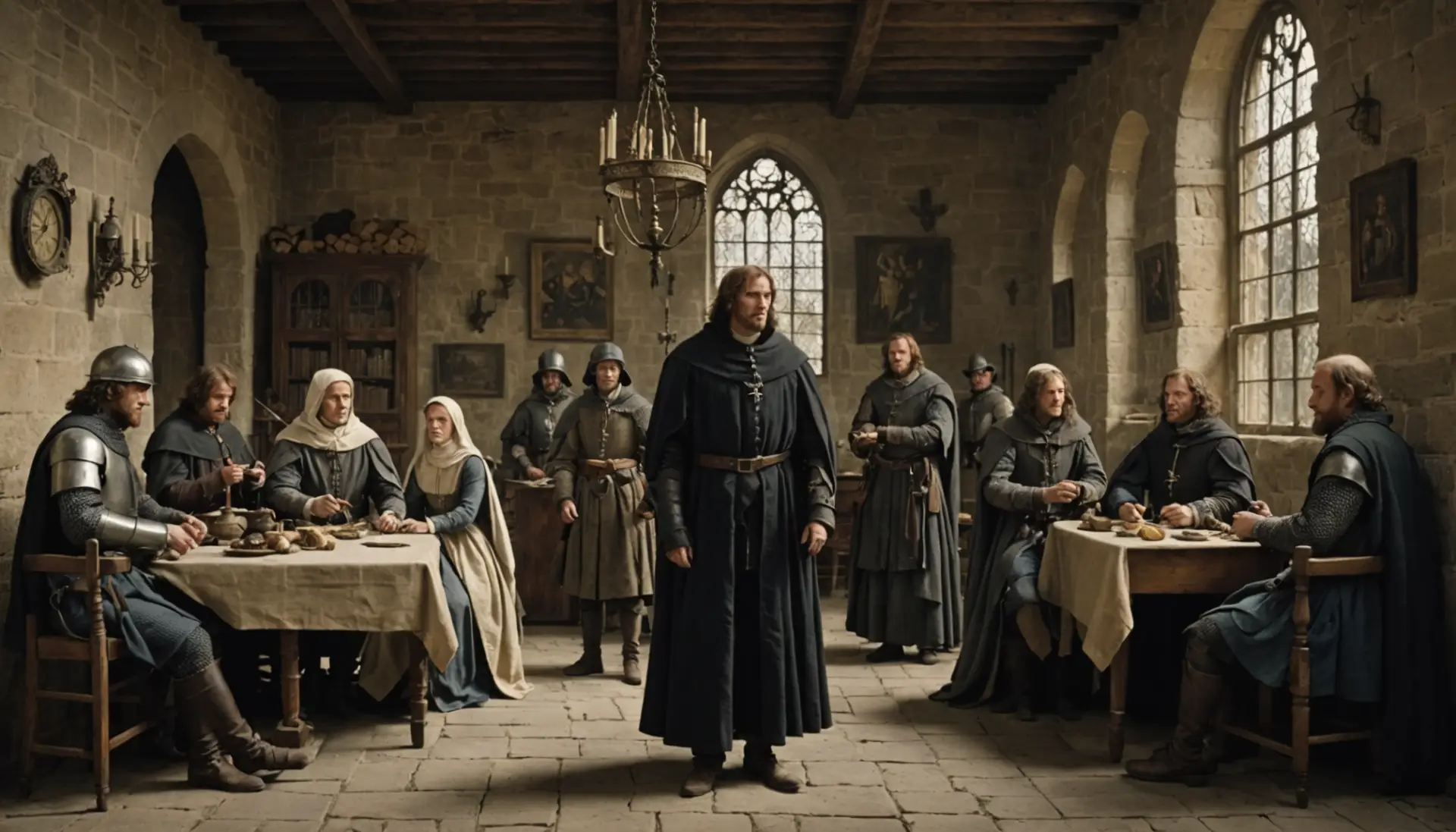
In the dim light of a medieval manuscript, the ink seems to pulse with a life of its own, whispering secrets of a time long past. Yet, what if that time was not as it appears? What if centuries had been fabricated, stitched together by the hands of those who wielded power? This unsettling notion is at the heart of the Phantom Time Hypothesis, a theory that suggests a significant portion of the early Middle Ages—specifically, the years between 614 and 911—never truly existed. The implications of such a claim are staggering, challenging the very foundation of historical understanding. As one delves deeper into this hypothesis, the air thickens with uncertainty, and the shadows of history loom larger.
The Phantom Time Hypothesis was first proposed by German historian Heribert Illig in the 1990s. Illig’s assertion was not merely a whimsical musing; it was rooted in a meticulous examination of historical records, calendars, and archaeological findings. He posited that the years in question were artificially added to the timeline, a product of political machinations and clerical errors. The idea that history could be manipulated to serve the interests of those in power is not new; it echoes through the ages, from the annals of ancient Rome to the chronicles of modern nations. Yet, Illig’s theory stands apart, suggesting an audacious erasure of time itself.
To understand the Phantom Time Hypothesis fully, one must first grasp the historical context of the Middle Ages. This period, often characterized as a dark age of ignorance and superstition, spanned roughly from the fall of the Western Roman Empire in 476 AD to the dawn of the Renaissance in the 14th century. It was a time marked by feudalism, religious upheaval, and cultural stagnation. Yet, it was also a time of profound transformation—an era that saw the rise of powerful kingdoms, the spread of Christianity, and the gradual rediscovery of classical knowledge. The Middle Ages were not merely a void; they were a complex tapestry woven from threads of conflict, faith, and resilience.
The years that Illig claims were fabricated fall within this intricate web. The early Middle Ages were defined by a lack of reliable historical documentation. Many records were lost or destroyed during invasions and wars, leaving historians to piece together fragmented accounts from various sources. This absence of concrete evidence has led to speculation and debate about what truly transpired during these centuries. Illig’s hypothesis taps into this uncertainty, suggesting that the gaps in our understanding are not merely due to lost records but rather to an intentional manipulation of time itself.
Illig’s claims hinge on several key assertions. He argues that the Gregorian calendar reform instituted by Pope Gregory XIII in 1582 was based on a flawed understanding of time that had been artificially extended. According to Illig, this reform was an attempt to correct a calendar that had been distorted by centuries of miscalculations. He also points to discrepancies in historical records, such as the absence of significant archaeological evidence for certain events and figures traditionally associated with this period. The lack of contemporary documentation for key events raises questions about their authenticity and invites scrutiny into how history is recorded and remembered.
However, Illig’s theory has not gone unchallenged. Critics argue that his claims are built on shaky foundations and rely heavily on selective interpretations of historical data. Many historians contend that while gaps in knowledge exist, they do not necessitate a complete rejection of the established timeline. The complexities of medieval history are often obscured by modern interpretations that fail to account for the nuances of the time. Critics assert that Illig’s hypothesis oversimplifies a rich and multifaceted era, reducing it to mere conjecture.
Moreover, the evidence presented by Illig and his supporters has been met with skepticism. Historians emphasize that while certain records may be sparse or inconsistent, this does not imply they are entirely fabricated. The nature of historical documentation is inherently flawed; it is shaped by the perspectives and biases of those who create it. The absence of evidence for specific events does not equate to their nonexistence but rather highlights the challenges historians face in reconstructing a coherent narrative from fragmented sources.
In light of these criticisms, alternative explanations for discrepancies in historical records have emerged. Some scholars suggest that variations in regional calendars and local practices may account for perceived inconsistencies in timelines. The Middle Ages were characterized by diverse cultures and traditions, each with its own methods of recording time. This multiplicity can lead to confusion when attempting to create a unified historical narrative. Additionally, advancements in archaeology have shed light on previously overlooked aspects of this period, revealing a more complex picture than Illig’s hypothesis allows.
The impact of the Phantom Time Hypothesis on historical understanding cannot be understated. It has sparked renewed interest in how history is constructed and challenged scholars to reevaluate their assumptions about the past. By questioning established narratives, Illig’s theory has opened up discussions about the nature of historical evidence and the reliability of sources. It has prompted historians to consider how power dynamics shape our understanding of history and how narratives can be manipulated for political ends.
Archaeology plays a crucial role in illuminating the complexities of the Middle Ages. Excavations have uncovered artifacts and structures that provide tangible connections to this enigmatic period. From crumbling castles to intricate pottery, these remnants offer glimpses into daily life, social structures, and cultural practices. They serve as counterpoints to theoretical claims like those made by Illig, grounding discussions about history in physical evidence rather than abstract conjecture.
Primary sources remain essential in historical research, providing firsthand accounts that breathe life into past events. Chronicles written by monks, letters exchanged between nobles, and legal documents from local courts offer invaluable insights into medieval society. These sources allow historians to piece together narratives that reflect the lived experiences of individuals during this time. However, they are not without their limitations; biases inherent in these documents can skew perceptions and complicate interpretations.
The debate surrounding the Phantom Time Hypothesis continues to unfold within academic circles and beyond. While some embrace Illig’s ideas as a radical rethinking of history, others view them as an affront to established scholarship. This discourse reflects broader questions about how we understand our past and how narratives are constructed over time. It challenges historians to confront their own biases and assumptions while navigating the murky waters of historical interpretation.
As one contemplates the implications of questioning the existence of the Middle Ages, it becomes clear that such inquiries extend beyond mere academic curiosity. They touch upon fundamental aspects of human identity—how we perceive ourselves within the continuum of time and how our understanding shapes our present and future. The notion that centuries could be fabricated forces us to confront uncomfortable truths about power, memory, and the fragility of historical narratives.
In conclusion, while the Phantom Time Hypothesis may seem like an eccentric footnote in historical discourse, its implications resonate deeply within our understanding of time and memory. It serves as a reminder that history is not merely a collection of dates and events but a living tapestry woven from countless voices and experiences. As scholars continue to grapple with its claims and counterclaims, they illuminate not only the complexities of medieval history but also the broader questions that define our relationship with the past. In an age where misinformation can easily distort reality, engaging with these debates becomes all the more vital—a testament to humanity’s enduring quest for truth amid uncertainty.