
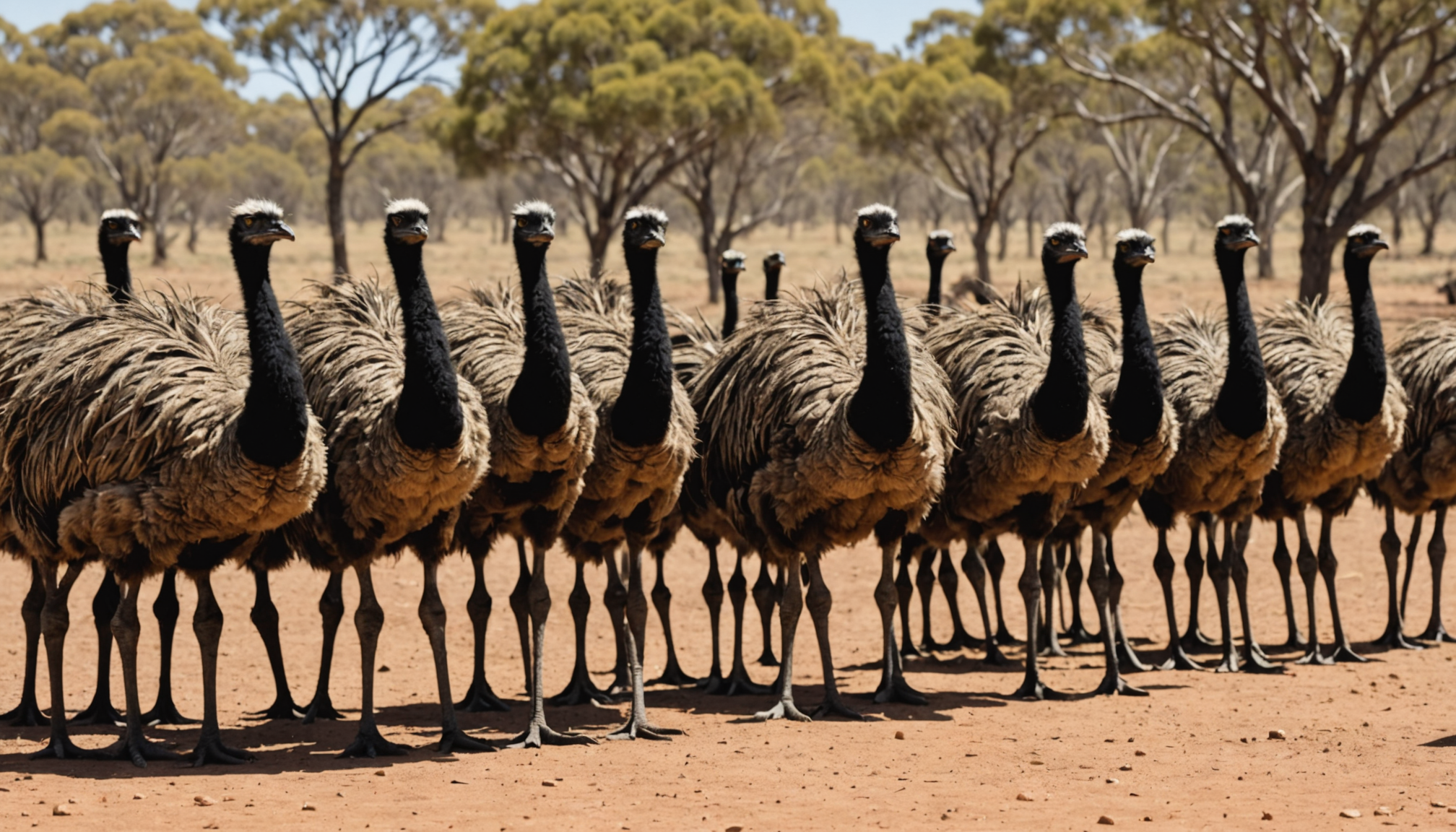
In the sun-drenched fields of Western Australia, a peculiar conflict unfolded in 1932, one that would come to be known as the Great Emu War. The air was thick with the scent of dust and the distant hum of cicadas, a backdrop to an unusual struggle between man and bird. Farmers, beleaguered by the relentless advance of emus, found themselves at odds with these large, flightless creatures. The emus, with their long legs and curious eyes, were not merely a nuisance; they were a formidable force that seemed to mock human efforts to control them. As the sun dipped low on the horizon, casting long shadows over the parched land, the stage was set for an encounter that would leave a lasting mark on Australia’s history.
The Great Emu War was not a war in the traditional sense, but rather a series of attempts to manage a burgeoning population of emus that had taken to raiding crops in the wheat belt of Western Australia. Following World War I, many veterans were granted land to farm, but they soon found themselves facing an unexpected adversary. The emus, migrating southward after their breeding season, descended upon the farmland in droves, trampling crops and devouring grain. The farmers’ frustration grew as they watched their hard work vanish beneath the feet of these seemingly invincible birds. The situation escalated quickly; what began as a nuisance transformed into a crisis that demanded intervention.
By late 1932, the plight of the farmers had reached the ears of government officials. The emu problem was no longer just a local concern; it had become a matter of national interest. The Australian government, keen to support its returning soldiers and maintain agricultural productivity, decided to take action. They dispatched soldiers from the Royal Australian Artillery to combat this avian menace. It was an unusual deployment, one that would soon be met with skepticism and ridicule. The military’s involvement was framed as a necessary measure to restore order and protect the livelihoods of those who had fought for their country. Yet, as they prepared for battle against a creature that had no concept of warfare, doubts began to creep in.
The soldiers arrived in the wheat belt armed with machine guns and a sense of purpose. They set up camp amidst the golden fields, where the air was heavy with the scent of ripening grain and the promise of harvest. The plan was straightforward: locate the emus and eliminate them before they could wreak further havoc. However, the emus proved to be more elusive than anticipated. They scattered at the first sound of gunfire, their instinctual flight response rendering them difficult targets. The soldiers quickly learned that these birds were not only fast but also remarkably intelligent, often outsmarting their human pursuers.
As days turned into weeks, the military’s efforts became increasingly futile. Initial skirmishes yielded minimal results; for every emu taken down, dozens more seemed to appear from nowhere. The soldiers found themselves in a bizarre game of cat and mouse, where the emus held all the cards. The landscape was littered with spent cartridges and frustration as men trained for combat against human foes grappled with an enemy that seemed impervious to their tactics. The sun beat down mercilessly on their backs as they trudged through the fields, their spirits waning with each failed attempt.
The turning point came when the emus began to strike back in their own way. With each failed assault, they grew bolder, venturing closer to the soldiers’ encampments and mocking their efforts with their distinctive calls. It was as if they were taunting their would-be hunters, asserting their dominance over the land that had once been theirs. The military’s humiliation deepened as reports of their ineffectiveness spread beyond the wheat belt. What had begun as a serious endeavor devolved into a farcical spectacle, drawing laughter from those who heard tales of men armed with machine guns being outmaneuvered by birds.
As November turned to December, the Great Emu War came to an anticlimactic end. The military withdrew from the fields, leaving behind a trail of unanswered questions and unfulfilled promises. The emus remained unscathed for the most part, continuing their reign over the wheat fields while farmers were left to pick up the pieces of their shattered crops. The government’s decision to intervene had backfired spectacularly; instead of restoring order, it had highlighted the absurdity of trying to wage war against nature itself. The emus had won this round, leaving behind a legacy that would haunt those involved for years to come.
Public reaction to the Great Emu War was mixed. Some viewed it as a comical episode in Australian history, while others saw it as a serious failure of government policy and military strategy. Newspapers across the country reported on the events with a blend of incredulity and humor, often depicting the soldiers as bumbling fools unable to conquer their feathered foes. Editorials questioned how such an embarrassing situation could arise in a nation that prided itself on its ruggedness and resilience. The laughter masked deeper concerns about agricultural sustainability and wildlife management that would linger long after the last shots were fired.
International attention also turned toward Australia as news of the Great Emu War spread beyond its borders. Foreign journalists arrived to witness firsthand this peculiar conflict that had captured imaginations worldwide. They found themselves drawn not only to the absurdity of men battling birds but also to the underlying issues that had led to such an unusual confrontation. In many ways, it became a cautionary tale about humanity’s relationship with nature—a reminder that even in an age of technological advancement and military prowess, there are forces beyond human control.
In retrospect, the Great Emu War offers several lessons about wildlife management and human intervention in natural ecosystems. It serves as a stark reminder that nature operates on its own terms, often defying human expectations and plans. The failure to effectively manage the emu population highlighted gaps in understanding animal behavior and ecology. It also raised questions about how societies respond to perceived threats from wildlife—whether through aggression or more sustainable coexistence strategies.
The legacy of this peculiar chapter in Australian history endures in various forms. It has become a symbol of folly and hubris—a reminder that even well-intentioned efforts can lead to unexpected outcomes when humans attempt to impose their will on nature. The Great Emu War has been referenced in discussions about wildlife conservation and management practices, serving as both a cautionary tale and an example of what can happen when humans underestimate their adversaries.
In popular culture, the Great Emu War has taken on a life of its own. It has inspired books, documentaries, and even comedic interpretations that explore its absurdity while reflecting on deeper themes of human-animal relationships. The image of soldiers armed with machine guns chasing after emus has become iconic—a representation of humanity’s struggle against forces it cannot fully comprehend or control.
As Australia reflects on this most embarrassing military campaign, it is essential to recognize that history is often written not just by victors but by those who learn from their failures. The Great Emu War stands as a testament to both human folly and resilience—a reminder that even in defeat, there are lessons to be gleaned from encounters with nature’s unpredictable forces. In the end, perhaps it is not just about winning or losing but about understanding our place within the intricate web of life that surrounds us.