
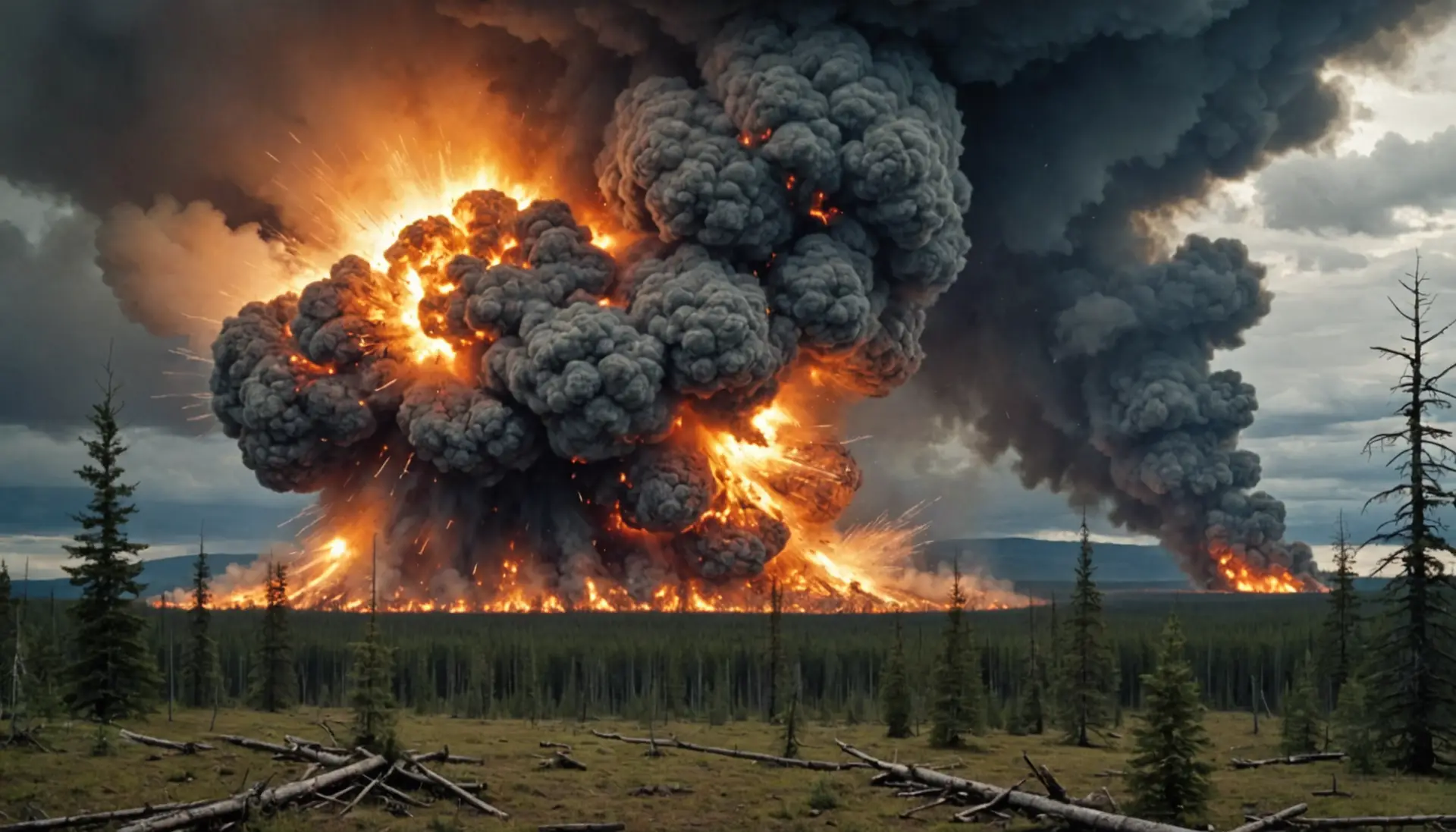
In the early hours of June 30, 1908, a blinding flash illuminated the skies over Siberia, followed by a thunderous roar that echoed through the vast, desolate expanse of the taiga. Trees were uprooted, flattened like matchsticks, and a shockwave rippled through the air, felt hundreds of miles away. The Tunguska Event, as it would come to be known, left no crater, no remnants of a conventional explosion, and yet its impact was undeniable. It was a moment that would haunt scientists and historians alike, a riddle wrapped in the enigma of nature’s fury. The world was on the brink of modernity, yet this strange occurrence seemed to belong to a different age—one where the forces of the universe could still surprise humanity in its hubris.
The Tunguska Event occurred in a remote part of Siberia, an area sparsely populated and largely untouched by the hand of civilization. The region was characterized by its dense forests, where the scent of pine mingled with the earthy aroma of damp soil. It was a summer morning, and the air was thick with humidity, the kind that clings to the skin and makes one feel as if they are wading through a dream. The explosion itself released energy equivalent to that of a nuclear bomb, leveling an estimated 80 million trees across 2,000 square kilometers. The devastation was so profound that it would take decades for scientists to fully grasp its scale. In the immediate aftermath, however, there were no witnesses to the event who could provide a coherent account; only the whispers of the wind through the fallen trees remained.
As news of the explosion began to filter out into the world, it sparked a flurry of speculation and intrigue. Theories ranged from the plausible to the fantastical. Some suggested that it was a meteorite or comet that had exploded in the atmosphere, while others posited more outlandish ideas involving alien spacecraft or secret weapons tests. The lack of physical evidence only fueled these theories, creating an atmosphere ripe for conjecture. In a time when science was beginning to unravel the mysteries of the universe, the Tunguska Event stood as a stark reminder of how little humanity truly understood about its own planet.
Theories about what caused the Tunguska Event proliferated like wildfire. The most widely accepted explanation is that a small comet or asteroid entered Earth’s atmosphere and exploded in an airburst above the ground. This hypothesis gained traction due to the absence of a crater and the nature of the destruction observed in the surrounding forest. However, even this explanation is fraught with uncertainties. How large was the object? What was its composition? These questions lingered in the minds of scientists who sought to piece together this cosmic puzzle. The event became a focal point for discussions about planetary defense and humanity’s vulnerability to celestial threats.
Yet, despite decades of research and investigation, many questions remain unanswered. The Tunguska Event is often cited as one of the most significant unexplained phenomena in modern history. The absence of definitive evidence has led to ongoing debates among scientists and researchers. Some argue that without physical remnants, it is impossible to draw conclusive connections between the event and any specific celestial body. Others contend that advances in technology and methodology may eventually yield new insights into what transpired that fateful day in 1908. The mystery continues to captivate those who seek to understand not just what happened, but why it remains so elusive.
The role of asteroid impact in explaining the Tunguska Event cannot be overstated. In recent years, scientists have turned their attention to near-Earth objects (NEOs) as potential threats to our planet. The Tunguska Event serves as a stark reminder of what could happen if such an object were to collide with Earth. The energy released during the explosion was immense—estimates suggest it could have been as powerful as 15 megatons of TNT. This realization has prompted increased interest in monitoring NEOs and developing strategies for planetary defense. The event has become a case study in understanding how celestial bodies interact with Earth’s atmosphere and what measures can be taken to mitigate potential risks.
Scientific investigations into the Tunguska Event have taken many forms over the years. In 1927, a Soviet expedition led by Leonid Kulik ventured into the heart of Siberia to study the aftermath firsthand. Kulik’s team faced numerous challenges: harsh weather conditions, difficult terrain, and a lack of resources. Yet their determination paid off when they discovered vast swathes of flattened trees and signs of an explosion that had altered the landscape forever. Subsequent expeditions have continued to explore the site, employing modern technology such as satellite imagery and ground-penetrating radar to uncover clues hidden beneath layers of earth and vegetation.
Eyewitness accounts from those who lived in proximity to the explosion add another layer of complexity to the narrative surrounding Tunguska. Local residents reported seeing a bright light streaking across the sky before being knocked off their feet by the force of the blast. Their testimonies paint a vivid picture of confusion and fear—a moment when time seemed to stand still as nature unleashed its fury. One villager recalled how his house shook violently, while another described how animals fled in terror from an unseen threat. These accounts provide invaluable insight into how ordinary people experienced an extraordinary event, yet they also highlight the limitations of human perception in grasping something so vast and incomprehensible.
The global impact of the Tunguska Event reverberated far beyond Siberia’s borders. News reports spread across continents, capturing public imagination and igniting curiosity about what had transpired in that remote corner of Russia. Scientists around the world began to take notice, leading to increased funding for research into meteorology and astronomy. The event served as a catalyst for discussions about natural disasters and their potential consequences on human civilization—a topic that remains relevant today as climate change and environmental degradation loom large on the horizon.
In reflecting on lessons learned from Tunguska, one cannot help but consider its implications for planetary defense and risk assessment. The event underscored humanity’s vulnerability to cosmic forces beyond its control—a humbling reminder that we are but small players on a vast stage. As scientists continue to monitor near-Earth objects and develop strategies for potential impacts, they are guided by the lessons gleaned from Tunguska: preparedness is essential, and understanding our place in the universe is paramount.
Commemorating the Tunguska Event has become an annual tradition for some who seek to honor its legacy. In 2008, on its centenary, various events were held across Russia and beyond—conferences, exhibitions, and discussions aimed at fostering awareness about cosmic threats and our responsibility toward safeguarding our planet. These gatherings serve not only as memorials but also as platforms for sharing knowledge and inspiring future generations to continue exploring this enduring mystery.
As time marches on, the Tunguska Event remains an enigma—a testament to nature’s power and humanity’s quest for understanding. Each new discovery brings with it both clarity and confusion; each theory proposed adds another layer to an already complex narrative. The search for answers continues unabated, driven by curiosity and an innate desire to comprehend our world. In this pursuit lies both hope and uncertainty—a reminder that some mysteries may never be fully unraveled but will continue to inspire wonder for generations to come.