
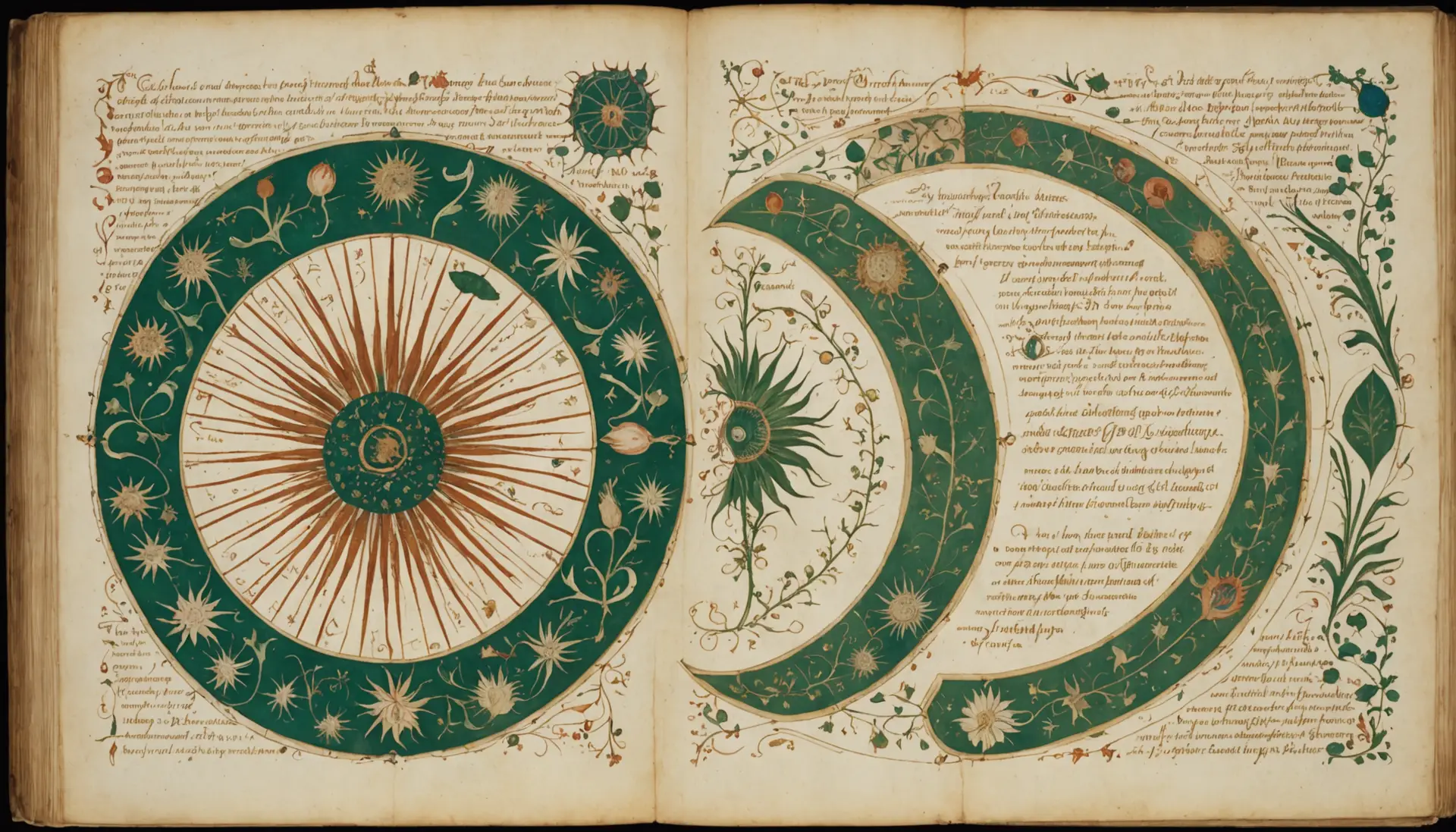
In the dim light of a library, a book rests quietly, its pages yellowed with age and its text a labyrinth of indecipherable symbols. The Voynich Manuscript, as it is known, has captivated the minds of scholars, cryptographers, and curious onlookers alike for centuries. Its very existence raises questions that linger in the air like the dust motes illuminated by the sun filtering through the window. What secrets lie within its pages? Who wrote it, and for what purpose? The manuscript is a riddle wrapped in an enigma, a testament to human curiosity and the relentless pursuit of knowledge. As one delves deeper into its history, the shadows of uncertainty grow longer, revealing a tapestry woven with intrigue and speculation.
The origins of the Voynich Manuscript are as elusive as the text itself. Believed to have been created in the early 15th century, its first known owner was a man named Wilfrid Voynich, an antiquarian bookseller who stumbled upon it in 1912 in a Jesuit college in Italy. The manuscript’s journey before reaching Voynich remains shrouded in mystery. Some suggest it may have been commissioned by a noble patron, while others speculate it could have been the work of a solitary scholar, perhaps even a hermit, lost in his own thoughts and experiments. The parchment bears signs of age, with faint watermarks that hint at its European origins, yet no definitive evidence has surfaced to pinpoint its creator or the circumstances surrounding its production.
As one examines the manuscript’s contents, the sense of disorientation deepens. The text is written in an unknown script that has defied all attempts at translation. It is a language that seems to dance across the pages, teasing the reader with its fluidity and complexity. The manuscript is divided into sections that appear to cover various subjects: herbal remedies, astronomical observations, and even what seems to be a form of alchemical knowledge. Each page is filled with intricate illustrations that accompany the text, yet their meanings remain just as elusive. The air around the manuscript feels charged with an unspoken tension, as if it holds secrets that are just out of reach.
Theories about the Voynich Manuscript abound, each more tantalizing than the last. Some scholars posit that it is an elaborate hoax, a clever ruse designed to confound and amuse. Others believe it may be a cipher or code, perhaps created by a secret society or an individual with esoteric knowledge. The notion that it could be a lost language or an entirely new form of communication has also been proposed. Each theory carries with it a weight of possibility, yet none have managed to unlock the manuscript’s secrets definitively. The uncertainty surrounding its purpose only adds to its allure, drawing in those who seek to unravel its mysteries.
Over the years, numerous attempts have been made to decipher the Voynich Manuscript. Cryptographers and linguists have poured over its pages, employing various methods ranging from statistical analysis to computer algorithms. Yet despite their best efforts, the text remains stubbornly resistant to interpretation. Some have suggested that the manuscript may contain encoded information about herbal medicine or astronomical phenomena, while others argue that it could be a work of pure fantasy, devoid of any real meaning. The frustration felt by those who have dedicated their lives to cracking its code is palpable; each failed attempt only deepens the manuscript’s enigmatic reputation.
The illustrations within the Voynich Manuscript are as captivating as the text itself. They depict strange plants that do not correspond to any known species, celestial diagrams that hint at an understanding of astronomy far beyond what was common in the 15th century, and figures engaged in mysterious rituals that evoke a sense of otherworldliness. The colors are vibrant yet muted by time, creating an ethereal quality that draws the viewer in. Each image seems to tell a story, yet without context or accompanying text, they remain tantalizingly incomplete. The air around these illustrations feels thick with possibility; they invite speculation but offer no answers.
Medieval ciphers played a significant role in the creation of texts during the time when the Voynich Manuscript was produced. The art of encoding information was not uncommon among scholars and alchemists who sought to protect their knowledge from prying eyes. It is possible that the manuscript employs such techniques, weaving together symbols and letters in a way that obscures meaning while hinting at deeper truths. This connection to medieval practices adds another layer of complexity to the manuscript’s already intricate narrative. It raises questions about who might have had access to such knowledge and what they hoped to achieve by encoding their thoughts in this manner.
The Voynich Manuscript has not only captured the attention of historians and linguists but has also seeped into popular culture in various forms. It has inspired novels, documentaries, and even works of art that explore its mysteries and implications. The allure of the unknown resonates with audiences who are drawn to stories of hidden knowledge and ancient secrets waiting to be uncovered. In this way, the manuscript transcends its physical form; it becomes a symbol of humanity’s eternal quest for understanding and meaning in a world filled with uncertainty.
The ongoing debate surrounding the Voynich Manuscript continues to fuel interest and speculation. Scholars remain divided on its significance and purpose; some argue for its historical value as a genuine artifact of medieval scholarship, while others dismiss it as an elaborate hoax or an exercise in futility. This discord reflects broader themes within academia regarding interpretation and meaning—how knowledge is constructed and deconstructed over time. As new technologies emerge and methodologies evolve, discussions about the manuscript’s relevance persist, ensuring that it remains at the forefront of scholarly inquiry.
Looking ahead, the future of deciphering the Voynich Manuscript remains uncertain yet hopeful. Advances in artificial intelligence and machine learning may offer new avenues for analysis that were previously unimaginable. As researchers continue to explore its pages with fresh eyes and innovative tools, there is a sense that perhaps one day, the veil shrouding its secrets may be lifted. Yet even if its text remains forever unreadable, the manuscript will continue to serve as a reminder of humanity’s insatiable curiosity—a testament to our desire to seek out knowledge even when faced with insurmountable odds.
In conclusion, the Voynich Manuscript stands as an enduring mystery that invites exploration and contemplation. Its origins are obscured by time; its contents elude comprehension; and its illustrations provoke wonder and speculation. As scholars grapple with its complexities and theories abound regarding its purpose, one thing remains clear: this enigmatic artifact will continue to captivate minds for generations to come. It embodies not only the quest for knowledge but also the recognition that some mysteries may never be fully unraveled—a poignant reminder of our place within an ever-expanding universe filled with questions waiting to be asked.