
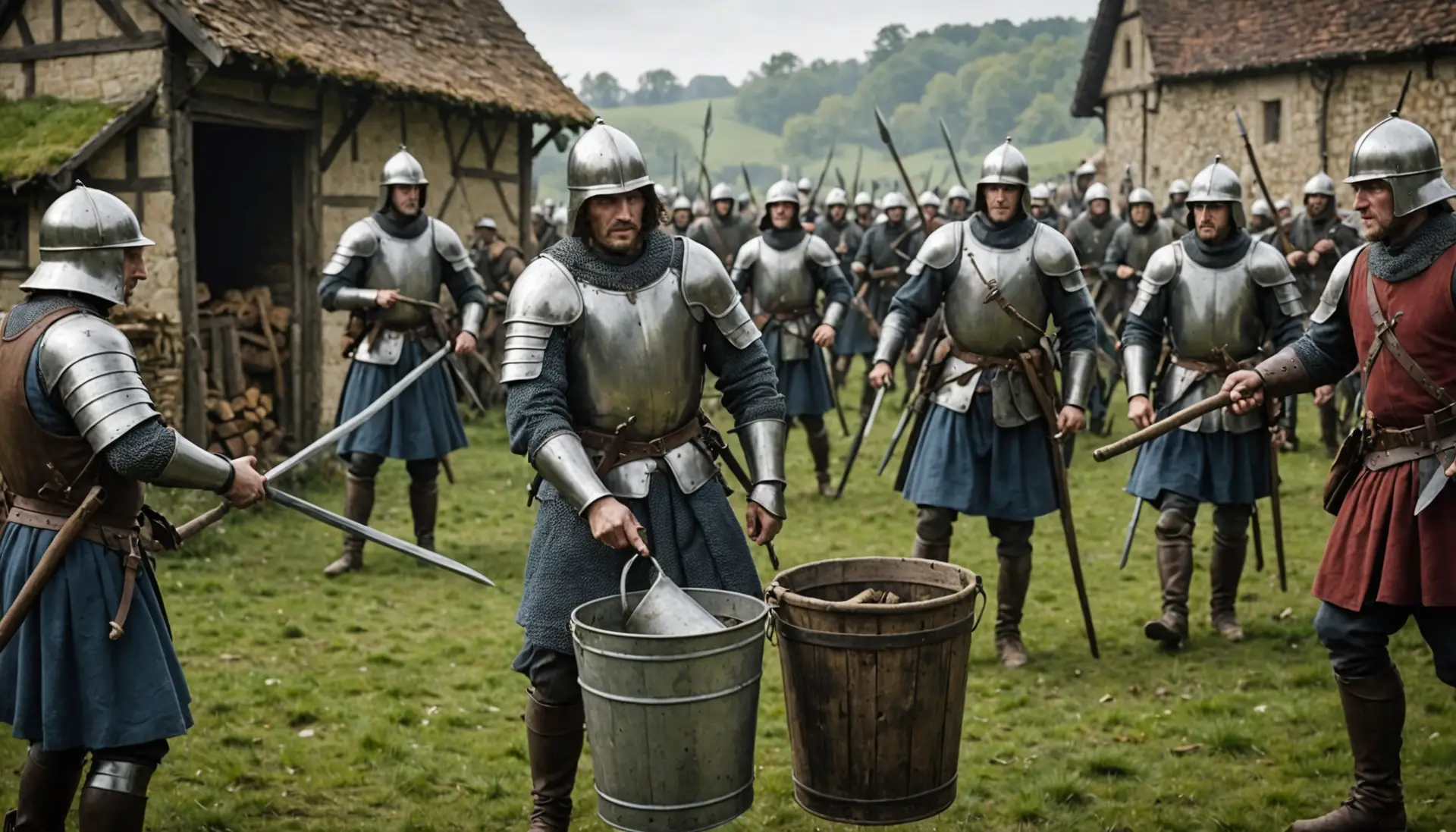
In the year 1325, a seemingly trivial object—a bucket—became the catalyst for a conflict that would embroil two powerful Italian city-states in a bitter war. The air was thick with tension as the sun dipped low over the horizon, casting long shadows across the cobblestone streets of Bologna and Modena. What began as a petty theft spiraled into a full-blown military engagement, drawing in allies and enemies alike, and leaving a mark on the historical landscape that would echo through the ages. The War of the Bucket, as it would come to be known, was not merely a struggle over a mundane item; it was a reflection of pride, honor, and the fierce rivalries that characterized medieval Italy.
The origins of this peculiar conflict can be traced back to a single event: the theft of a bucket from a well in Modena. This was no ordinary bucket; it was a symbol of civic pride, crafted with care and imbued with the spirit of the Modenese people. The act of its theft was perceived as an affront, a challenge to their dignity that could not go unanswered. The citizens of Modena, fueled by indignation and a desire to reclaim their honor, rallied together. They viewed the bucket not just as a vessel for water but as an emblem of their identity. In Bologna, however, the theft was met with mockery and derision. The Bolognese saw themselves as superior, their city more refined and cultured. They could hardly fathom why such a trivial matter would provoke such outrage. Yet, in their dismissal lay the seeds of conflict.
As tensions escalated, both sides prepared for confrontation. The Battle of Zappolino became the focal point of this burgeoning war, a bloody clash that would see men driven by loyalty and rage face off in a struggle that seemed absurd in its origins. On that fateful day in November, the air was crisp with the chill of autumn, and the ground was damp from recent rains. The battlefield was set against a backdrop of rolling hills and fields that had witnessed centuries of conflict. As soldiers from Modena and Bologna gathered, the atmosphere crackled with anticipation. The clang of armor and the shouts of commanders filled the air, drowning out the rustling leaves and distant birdsong.
The battle itself unfolded with a ferocity that belied its origins. Men fought not just for victory but for their very identities, their cities’ honor hanging in the balance. The clash of swords rang out like thunder, punctuated by cries of pain and defiance. Blood soaked into the earth, mingling with fallen leaves, transforming the landscape into a grim tableau of human struggle. In the chaos, it became clear that this was more than just a fight over a bucket; it was a manifestation of deep-seated rivalries that had simmered for years. The outcome would not only determine who possessed the bucket but would also shape the future of both cities.
Bologna stood at the heart of this conflict, its streets echoing with the fervor of its citizens. Known for its universities and vibrant culture, Bologna was a city that prided itself on intellect and sophistication. Yet beneath this veneer lay an undercurrent of aggression toward its neighbors. The theft of the bucket had ignited long-standing grievances, and as news of the battle spread, citizens rallied to support their soldiers. The city’s leaders understood that this was not merely about reclaiming a stolen object; it was about asserting dominance in a region rife with competition. The stakes were high, and failure was not an option.
Surrounding city-states watched with keen interest as Bologna and Modena clashed. Each had its own ambitions and rivalries, and the War of the Bucket presented an opportunity to either ally with one side or take advantage of the chaos. Ferrara and Reggio Emilia were quick to lend their support to Modena, seeing in their struggle a chance to weaken Bologna’s influence. Meanwhile, other cities remained neutral, calculating their moves carefully as they observed the unfolding drama. The alliances formed during this time were often tenuous, driven by self-interest rather than loyalty. In this intricate web of politics and warfare, every decision carried weight.
The aftermath of the War of the Bucket left both cities scarred yet resolute. Modena emerged victorious, having claimed not only the bucket but also a renewed sense of pride among its citizens. However, victory came at a cost; lives were lost, families shattered, and resources depleted. Bologna, humiliated by its defeat, faced internal strife as citizens grappled with their city’s tarnished reputation. The war had exposed vulnerabilities that would take years to mend. In many ways, both cities were left to ponder what had been gained and what had been irrevocably lost in their pursuit of honor.
As time passed, the War of the Bucket faded into obscurity, yet its legacy lingered on in the collective memory of those who lived through it. It became a cautionary tale about pride and folly—a reminder that even the most trivial matters could escalate into profound conflict. The bucket itself became an artifact of local lore, its story woven into the fabric of both cities’ histories. In Modena, it was celebrated as a symbol of resilience; in Bologna, it served as a reminder of hubris and defeat.
In medieval society, objects like buckets held more significance than mere utility; they were imbued with meaning that transcended their physical form. A bucket represented sustenance, community, and shared labor—elements essential to life in an era where survival often hinged on cooperation among neighbors. The theft of such an object struck at the heart of social cohesion, igniting passions that could lead to war. This incident illustrated how deeply intertwined material culture was with identity and pride in medieval communities.
When viewed through the lens of history, the War of the Bucket stands as an intriguing case study in human behavior and societal dynamics. It reflects broader themes present in medieval Europe: territorial disputes, civic pride, and the fragile nature of alliances. The conflict unfolded against a backdrop of shifting power dynamics among city-states vying for dominance in an increasingly competitive landscape. It serves as a reminder that even seemingly insignificant events can have far-reaching consequences when they tap into deeper currents within society.
In popular culture today, references to the War of the Bucket may be few and far between; however, its absurdity has not gone unnoticed by historians and storytellers alike. It has become emblematic of how human folly can lead to conflict over trivial matters—an idea that resonates across time and geography. The story has been recounted in various forms: from academic discussions to satirical retellings that highlight its inherent absurdity. In this way, it continues to capture imaginations while serving as a lens through which to examine human nature.
Ultimately, lessons can be gleaned from this peculiar episode in history. The War of the Bucket reminds us that pride can blind individuals and communities to reason; it illustrates how quickly tensions can escalate when honor is perceived to be at stake. In an age where communication is instantaneous and global conflicts can arise from misunderstandings or miscommunications, reflecting on such historical events may offer valuable insights into contemporary issues. As humanity continues to grapple with its own complexities, perhaps there is wisdom to be found in recognizing that even small disputes can spiral into larger conflicts if left unchecked.
In conclusion, while the War of the Bucket may seem like an oddity from centuries past—a mere footnote in history—it encapsulates fundamental truths about human nature and societal dynamics that remain relevant today. It serves as both a cautionary tale and an exploration into how seemingly trivial matters can ignite passions leading to profound consequences. As we navigate our own world filled with complexities and rivalries, perhaps we would do well to remember that sometimes it is not just about what is taken but what is at stake when we choose to fight for our honor.